
View Certified Lab Results

Client Log In
Riverside County
San Diego County
RCR Environmental
RCR Environmental

Promoting Healthier Living through Expert Mold Testing and Professional Mold Removal

Home Maintenance

How to Replace a Wax Ring on Your Toilet (And Why Waiting Can Cost You Thousands)

RCR Environmental Team · February 5, 2025

A failing wax ring is one of the most common "quiet leaks" in a home. The toilet may still flush normally, the floor might look fine, and you may not smell anything. But if water is escaping under the toilet base, it can soak into subflooring and framing where you won't see it—until the damage is expensive.

Just as important: leaks at the toilet flange (below the wax ring) are treated differently than a clean plumbing drip. Because the wax ring seals the toilet to the sanitary drain connection, restoration standards generally presume contamination risk by default even when there's no visible sewage—similar to how sewage cleanup is handled differently than a clean supply line break. That distinction is one reason "I replaced the ring" isn't always the end of the story.

Local note (Murrieta / Riverside County): Riverside County uses the California Building Standards (Title 24), including the California Plumbing Code, as the baseline for compliant plumbing work.
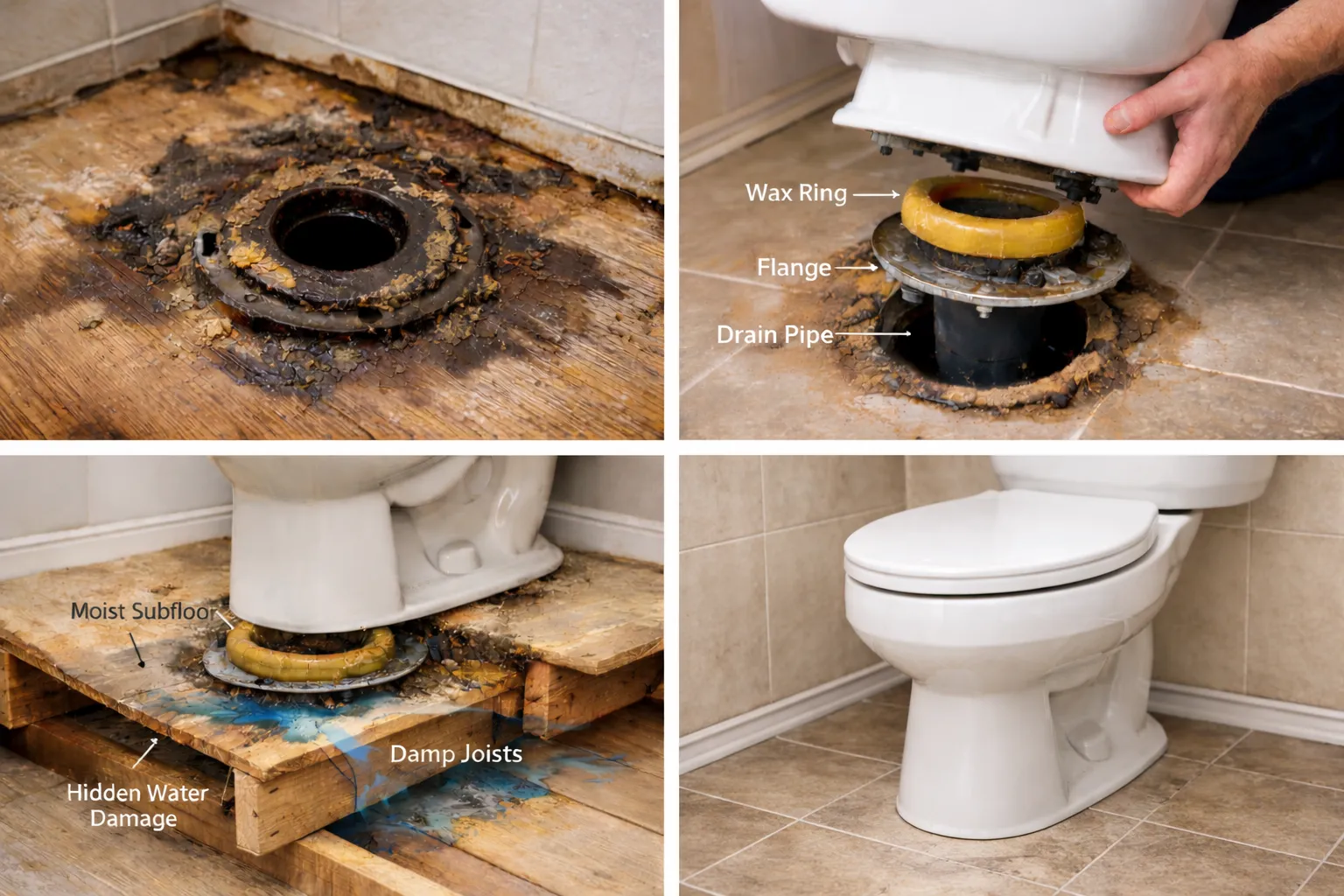
Diagram showing toilet wax ring, flange, and subfloor connection where hidden water damage commonly occurs

Quick Answer: Should You DIY a Wax Ring Replacement?

You can DIY it if:

  • The toilet is stable and you can lift it safely
  • The flange is intact and not below the finished floor (a common issue after flooring changes)
  • There's no soft/rotting floor, staining, or persistent odor
  • You're comfortable re-setting a toilet without cracking it or misaligning the flange

You should pause and inspect further if:

  • The toilet rocks at all
  • The floor feels spongy near the base
  • Caulk keeps discoloring or separating
  • There's staining on the ceiling below
  • You've had repeated "mystery odors" near the bathroom

Why a Wax Ring Failure Is a "Higher-Risk" Leak

Most homeowners think about a toilet leak like a normal water leak. But a wax ring sits at the intersection of the toilet and the sanitary drainage system. When leakage is occurring at or under that connection, professional restoration practice treats it as a higher-risk scenario because the water may be contaminated by what it contacted at the drain interface—even if you never see sewage.

This is also why, in California, ongoing dampness and visible mold can become a code enforcement / habitability issue if it's not corrected. California public health guidance explains that visible mold at hazardous levels and dampness can make housing substandard and can be cited by local code enforcement.

Tools and Supplies You'll Need

  • New wax ring (standard or extra-thick depending on flange height)
  • New closet bolts (recommended)
  • Putty knife/scraper (for old wax)
  • Disposable gloves + trash bag
  • Adjustable wrench / deep socket
  • Level (helpful)
  • Optional: new toilet supply line (cheap insurance)
  • Optional: flange repair ring (if flange is cracked or corroded)
  • Optional: plastic shims (if the toilet rocks after reset)

Step-by-Step: How to Replace the Wax Ring

1) Shut Off Water and Drain the Toilet

  • Turn off the shutoff valve behind the toilet
  • Flush and hold the handle down to empty the tank
  • Sponge out remaining water from tank/bowl if you want to reduce mess

2) Disconnect the Supply Line

  • Place a towel down first. Loosen the nut at the fill valve and/or shutoff

3) Remove the Toilet

  • Pop off the bolt caps
  • Remove nuts from closet bolts
  • Rock gently and lift straight up
  • Set the toilet on cardboard or a towel

4) Remove Old Wax and Inspect the Flange

Scrape wax off the toilet horn and flange.

Inspection checklist (this is where the real money is saved):

  • Is the flange cracked, rusted, or loose?
  • Is the subfloor dark, swollen, soft, or crumbling?
  • Any signs of moisture migration beyond the base footprint?
  • Is the flange sitting too low (common after tile/vinyl overlays)?

If the flange is compromised, fix that before resetting the toilet. A new wax ring won't compensate for a broken flange.

5) Install the New Wax Ring and Reset

  • Install new closet bolts
  • Place the wax ring (on flange or toilet horn—follow ring directions)
  • Lower the toilet straight down, centered, without twisting
  • Compress wax by sitting/pressing gently, then tighten nuts evenly

Important: Don't overtighten. You can crack the porcelain.

6) Reconnect Water and Test

  • Turn water back on, let tank fill, flush multiple times, and inspect for leaks

7) Caulk (or Don't) the Base—Do It Thoughtfully

Many pros caulk the base for hygiene and stability, but leaving a small gap at the back can make future leaks more obvious. If you caulk, do a clean bead and leave a small weep gap.

The Hidden-Cost Part: What Happens Under the Floor

A toilet can leak for weeks or months without dramatic symptoms. Moisture can soak into:

  • Underlayment
  • OSB/plywood subfloor
  • Baseboards
  • Lower wall plates
  • Joists (depending on layout)

This is where you shift from "plumbing repair" to "building science."

The 48-hour rule matters here. Industry guidance and the EPA are consistent: mold can begin developing on wet materials within 24–48 hours. A wax ring doesn't fail and get noticed in 48 hours—most of the time, these leaks have been active for weeks or months before anyone catches them. That means by the time you pull the toilet and see staining, the moisture has likely been in contact with porous materials well past the window where simple drying is effective.

Once porous building materials (subfloor, framing, insulation) have been wet for an extended period—especially from a sanitary drain connection—drying alone may not be enough. At that point, the appropriate response typically involves a professional moisture assessment and, in many cases, selective removal of affected materials (remediation), not just replacing the wax ring and hoping for the best.

California renter/health guidance emphasizes that dampness is what drives mold and that visible mold, wet materials, and musty odor are warning signs.

You don't have to assume the worst. But you do want to verify what you can't see—because the answer determines whether you're dealing with a simple seal replacement or a remediation project.

How to Check for Hidden Damage After a Wax Ring Leak

Start With the "Low-Tech" Indicators

  • Toilet rocking or loosening bolts over time
  • Musty odor that returns after cleaning
  • Discoloration at the base caulk line
  • Floor feels soft near the toilet
  • Vinyl seams lifting / laminate swelling
  • Grout staying dark or "wet-looking" near the base

Then Do the Smart Checks

  • Use a moisture meter around the perimeter of the toilet footprint (if you have one)
  • Inspect the ceiling below (if there's a lower floor)
  • If accessible, look from below (crawlspace/basement) for staining, darkened wood, or fastener corrosion

If you find moisture or compromised materials, that's the moment to involve a pro—because the next decisions affect:

When to Call a Professional (and Why "Just Drying It" May Not Be Enough)

If the leak has clearly affected porous materials, the right next step isn't "spray something and hope." It's:

  • Identify the moisture pathway
  • Verify extent (including concealed areas)
  • Decide on appropriate cleaning/drying vs. removal based on material condition and risk

Here's the reality most homeowners don't hear: if a wax ring has been leaking long enough to stain, soften, or warp the subfloor, that moisture has almost certainly been present for far longer than 48 hours. At that duration—especially at a sanitary drain connection—professional remediation is typically the appropriate path, not just drying. Affected subfloor, framing, or insulation may need to be selectively removed, treated, and rebuilt to properly resolve the issue.

That approach aligns with public guidance from the CDC: fix the water problem first, and address mold/dampness promptly. When materials have been wet too long, "promptly" means remediation—not a fan and a prayer.

FAQs

Is a wax ring leak considered a sewage loss?

Not always in the "obvious sewage everywhere" sense—but because the leak occurs at the sanitary waste connection, restoration standards commonly treat leakage below the wax ring as contamination-suspect by default. That's why pros handle it differently than a clean supply leak.

Can I just replace the wax ring and move on?

If the subfloor is solid, dry, and shows no staining or softness—yes, replacing the ring and moving on is reasonable. But if there's any evidence of moisture migration (staining, softness, odor, discoloration), keep in mind that the leak has almost certainly been active for well longer than 48 hours. At that point, replacing the ring stops the leak but doesn't address what's already happened to the materials underneath. A professional assessment can tell you whether structural drying is sufficient or whether selective removal and remediation is the safer path.

Why do I smell something even if I don't see water?

A failing wax ring can allow sewer gas to escape, and intermittent moisture can feed odors below the floor. Odor alone isn't proof of mold—but it is a reason to inspect.

Will homeowners insurance cover wax ring damage?

It depends on policy language and whether it's considered sudden/accidental vs. long-term seepage. Document what you found (photos of wax ring failure, subfloor staining, moisture readings, etc.) and talk to your carrier.

Is mold always the outcome?

No. Moisture is the enabling condition, not a guarantee. The point is verification. The EPA and CDPH both emphasize moisture control as the practical priority.

What can I cite if I'm a landlord or tenant in California?

CDPH guidance explains that hazardous visible mold and dampness can be treated as substandard housing conditions and can be cited by local code enforcement. California's habitability standards also apply.

Key Takeaways

  • A wax ring leak can be silent and damage subfloors before you see anything
  • Leaks below the wax ring are treated as higher-risk because they originate at the sanitary drain connection
  • Stop the leak, then verify below the surface (subfloor, edges, and underside if accessible)
  • In California, persistent dampness and hazardous visible mold can be a code enforcement / habitability issue
  • Riverside County relies on California Building Standards (Title 24), including the California Plumbing Code, for compliant work

Written by RCR Environmental (Murrieta, Riverside County). We perform moisture investigations, mold inspections/testing, and remediation planning. Serving Murrieta, Temecula, Menifee, Wildomar, Winchester, and Riverside County. This article is general information and not a substitute for a site-specific evaluation.
Need Professional Mold Help?

Our certified team is ready to help you with mold inspection, testing, and remediation. Contact us for a free assessment.

Discussion

36 comments on “How to Replace a Wax Ring on Your Toilet (And Why Waiting Can Cost You Thousands)

K
Kevin D.Hemet, CA

I work in construction and I can't tell you how many times I've pulled a toilet on a job and found a horror show underneath. Homeowners always say "it was fine, it just rocked a little." Then you pull it and the subfloor looks like it lost a fight with a swamp. This article is spot on — especially the part about the contamination angle at the drain connection. That's the piece most people completely miss. It's not just water, it's what that water touched on the way out.

D
Diana S.Temecula, CA

Our toilet has been doing a little wobble dance for a while now. No water, no smell, it just rocks a tiny bit when you sit down. My husband says it's fine. After reading this, I don't think it's fine. We've been in the house 12 years and I'm pretty sure the wax ring is original. Should I be worried or am I overthinking this?

G
Greg H.Murrieta, CA

Diana, you are not overthinking it. I'm the guy who thought squeegeeing after showers was "too much effort" (I commented on another article here a while back about that). Guess who also ignored a wobbly toilet for a year? This guy. When I finally pulled it, the wax looked like a melted candle that gave up on life. No major damage yet, but it was damp around the flange. My wife's "I told you so" was heard across all of Murrieta.

D
Diana S.Temecula, CA

Greg, I'm sending your comment to my husband because he IS you. The "it's fine" energy is strong in this one. Guess we know what we're doing this weekend. I'd rather deal with a $15 wax ring now than a therapy session about why our subfloor smells like a sewer. Thank you for the push.

R
RCR EnvironmentalMurrieta, CA

Diana, you're definitely not overthinking it. A toilet that rocks even slightly means the seal between the wax ring and the flange isn't stable, and over 12 years that seal has almost certainly compressed or shifted. Greg's experience is really common — what looks like "just a wobble" on the surface often tells a different story underneath. The wax ring replacement itself is straightforward and inexpensive. The risk you're avoiding by catching it now is months of slow, invisible moisture getting into the subfloor — which is where the real costs start adding up. If you want peace of mind before pulling the toilet, a quick moisture reading around the base can tell you whether there's already seepage happening below the surface. Either way, you're smart to catch this now rather than discovering it a year from now when the floor feels spongy.

K
Kelly M.Winchester, CA

The insurance FAQ was exactly what I needed. Our adjuster just denied our claim saying "long-term seepage" isn't covered. Meanwhile we have a softball-sized water stain on the ceiling below the bathroom. So the toilet leaked long enough to cause real damage but because it leaked for a long time it's not covered? Make that make sense. We're documenting everything now and pushing back.

R
RCR EnvironmentalMurrieta, CA

Kelly, sorry to hear about the denial — unfortunately this is one of the most common frustrations we see with wax ring damage. Insurers frequently use the "long-term seepage" exclusion even when the homeowner had no reasonable way to know the leak was happening. A few things that can help if you're pushing back: have an independent assessment done that documents the damage extent and establishes a timeline. The key argument is often that the failure was "sudden and accidental" from the homeowner's perspective — you didn't know the wax ring failed until the damage became visible. Most policies also distinguish between the "resulting damage" (water-damaged ceiling, subfloor) which may be covered, and the "source repair" (the wax ring itself) which usually isn't. Having a professional moisture assessment and mold test on record gives you concrete evidence to counter the adjuster's position. This is something we handle from A to Z — moisture mapping, mold sampling, damage scope documentation — and our reports are written with your interest in mind, not the insurance company's. If you're still in the pushback phase, give us a call and we can do an independent assessment that gives you real ammunition for your appeal. A public adjuster can also be worth the cost if the claim amount is significant — they work on your behalf and know exactly which policy language to leverage.

J
Jennifer M.Temecula, CA

OK so after our lovely experience hiring a contractor who ripped out drywall with zero containment last year (I commented about that on the containment article), I decided to DIY the wax ring replacement myself. Watched three YouTube videos, read this article twice, bought the supplies. You know what? I DID IT. Pulled a toilet by myself, scraped off wax that looked like it's been there since the Clinton administration, found a cracked flange, installed a repair ring, re-set everything. Total cost: $28 and my dignity when I couldn't stop gagging at the old wax. I'll take that over another contractor disaster.

P
Patricia H.Fallbrook, CA

Jennifer, you are my hero. Meanwhile my husband's idea of "fixing" things is the same approach he took with our mold problem — brute force and denial. He tried to replace our wax ring, cross-threaded a bolt, cracked the toilet base, and we ended up buying a whole new toilet. Sometimes the $200 plumber call is the cheaper option. But seriously, good for you for doing it right.

J
Jason W.Perris, CA

So remember me, the genius who kept repainting over bubbling paint on my bathroom ceiling? (I commented on the early signs article about that.) Well, I finally had someone come look at it and GUESS WHAT — the toilet directly above on the second floor had a failing wax ring. The water had been seeping down into the ceiling below for who knows how long. The bubbling paint wasn't a paint problem, it was a toilet-leaking-through-the-floor problem. I feel like an idiot for painting over it four times.

C
Carlos P.Lake Elsinore, CA

Jason, don't feel too bad. You'd be amazed how many people do the exact same thing. When we had our mold remediation done (I wrote about the containment costs on another post here), the crew told us that ceiling staining below bathrooms is one of the most common things they see — and it's almost always a wax ring or a shower pan. At least you found it before the ceiling came down. That's a win in my book.

B
Brian K.French Valley, CA

Real question — the article talks about contamination at the drain connection and the 48-hour rule. How do you actually know if you have Category 3 water damage versus Category 1 or 2? Our toilet had a slow leak at the wax ring for maybe a month before we caught it. Is that automatically Category 3 because it's near the drain, or does it depend on whether it was clean water leaking out?

K
Kevin D.Hemet, CA

Brian, good question. The IICRC S500 standard is the industry reference for this — it lays out the three categories. Category 1 is clean supply water like a burst pipe from the wall. Category 2 is gray water, dishwasher or washing machine overflow. Category 3 is sewage or anything that contacted sewage, which includes the drain side of a toilet. If the water touched or came from below the wax ring seal — meaning it had contact with the drain line — it's Cat 3 regardless of how clean it looked. The S500 also says that Category 1 or 2 water that sits for more than 48 hours gets automatically reclassified as Category 3 due to bacterial growth. So even if your leak started clean, a month of sitting on subfloor puts you in Cat 3 territory. I've seen guys on jobs try to argue it was "just condensation" to avoid the Cat 3 protocol and that's how you end up with problems down the road.

T
Tanya R.Canyon Lake, CA

The simplest way I've heard it explained: if you wouldn't drink the water, it's not Category 1. If you wouldn't wash your hands in it, it's not Category 2. And if it came from anywhere near where your toilet does its business, congratulations, you've got Category 3 and a really fun weekend ahead of you. Ask me how I know.

S
Stephanie R.Menifee, CA

Update for anyone who remembers my comment on the early signs article about a musty smell in our hallway that we couldn't find the source of. FOUND IT. It was the wax ring in the bathroom right off the hallway. Not leaking water visibly, but letting just enough sewer gas through to create that earthy smell we'd been chasing for months. The plumber said the ring was "toast" — his word, not mine. New ring, smell gone. Sometimes the answer is literally right under your nose. Or your toilet, I guess.

M
Marcus T.Murrieta, CA

We're in escrow on a house in Murrieta and the inspection flagged a rocking toilet in the master bath. Seller says "oh it just needs the bolts tightened, no big deal." After reading this I'm thinking that's like saying a check engine light just means the dashboard sticker is loose. Has anyone dealt with this during a home purchase? I don't want to lose the house over a toilet, but I also don't want to inherit someone else's sh***y situation. Literally.

F
Frank D.Canyon Lake, CA

Marcus, get it checked before closing. Trust me. When we bought our Canyon Lake place, we didn't push on a few "minor" things the seller brushed off. Ended up finding mold behind the bedroom drywall from an old roof leak that probably would've been caught if we'd been more thorough during escrow. A $200 plumber call during contingency could save you thousands and a massive headache. Ask for a repair credit if there's damage. Don't take the seller's word for anything.

A
Amanda J.De Luz, CA

Has anyone tried the wax-free rubber gasket rings instead of traditional wax? Our plumber recommended one when he replaced ours and said they're more forgiving if the toilet ever needs to come off again. But my dad swears by the old-school wax and says anything else is "newfangled garbage that'll leak in six months." Looking for real-world opinions before my next plumber visit turns into a family debate.

D
David R.Murrieta, CA

Amanda, I've used both. Wax-free on two toilets, traditional wax on one. Three years in, no leaks on any of them. The wax-free is way easier to work with — you can reposition the toilet if you don't nail the placement on the first try. With wax, once you set it down, you get one shot or you're scraping and starting over. Your dad isn't wrong that wax has a longer track record, but the rubber gasket rings have been around long enough now that I'd trust them. Just make sure you get the right size for your flange depth.

G
Greg H.Murrieta, CA

Amanda, I'm going to respectfully disagree with your dad while also acknowledging that if my father-in-law heard me say "wax-free ring" he would disown me. I used a wax-free on my replacement and it's been solid for two years. The peace of mind of knowing I can pull the toilet again without recreating a crime scene at a candle factory was worth the extra $8. Tell your dad the internet strangers are split. That should really settle things.

R
Ryan M.Sun City, CA

PSA for anyone with elderly parents: go check their toilets. Seriously. My mom's guest bath toilet was leaking for who knows how long and by the time she mentioned the floor "felt bouncy," the subfloor around the flange was completely gone. We had to cut out a 4x4 section and sister a joist. She never smelled anything because her sense of smell isn't what it used to be. A five-minute wobble check could save your parents a really expensive problem they don't need.

C
Catherine E.Murrieta, CA

The 48-hour rule section hit hard. Our plumber estimated our wax ring had been leaking for at least 6 months based on the staining. So we're way, way past the "just dry it out" window. Scheduling a moisture assessment this week. Part of me doesn't want to know what they find, but the smarter part of me knows ignoring it only makes the bill bigger. Wish us luck.

L
Lisa G.Wildomar, CA

Good luck Catherine. We went through something similar — slow toilet leak, months of it going unnoticed. The assessment found the subfloor was compromised and there was growth starting on the framing. Not the news you want to hear, but WAY better to catch it and fix it properly than to keep wondering. The crew that did our remediation was in and out in two days and the peace of mind was worth every penny. You're doing the right thing.

D
Diane L.Homeland, CA

Well here I am again. Last time I commented on the mold prevention article about being a renter with no bathroom exhaust fan and a landlord who doesn't respond to anything. Now our toilet is rocking AND there's a smell. I'm starting to think my landlord's maintenance strategy is "if you ignore it long enough, the tenant moves out and it becomes the next tenant's problem." The habitability standards link in this article is getting bookmarked. And forwarded. With a timestamp.

T
Tony R.Rainbow, CA

Diane, I feel for you. Document everything — email, photos, dates. We went through a landlord nightmare with a slow kitchen leak at our old rental (I commented about finding it on the prevention post). What finally worked was putting it in writing and referencing the specific CDPH guidance about dampness and substandard housing. Once our landlord realized we'd actually done the homework, suddenly a plumber was available the next week. Funny how that works. Don't give up.

R
Rachel P.Menifee, CA

OK I'm scared to ask but what does this actually cost when the subfloor is damaged? Our plumber just pulled our toilet for a new wax ring and called us in to "take a look." The plywood around the flange is black and soft. He put the toilet back temporarily and said we need a "real repair" before he'll install the new ring. I have no idea what I'm looking at cost-wise. Are we talking hundreds or thousands?

C
Carlos P.Lake Elsinore, CA

Rachel, honest range from what I've seen and experienced: if it's just the subfloor around the flange — small section, maybe 2x2 feet — you're probably looking at $400-800 for a handyman or plumber to cut out the bad section, sister any joists if needed, patch in new plywood, install a new flange, and re-set the toilet. If the damage spread further or there's mold on the framing underneath, add remediation costs — that can run $1,500-3,000+ depending on scope. The CDC recommends professional remediation for any mold area larger than about 10 square feet, and with toilet leaks you can't always see how far it spread without pulling things up. If you need a mold clearance test after, another $300-500. The good news is a small repair caught early is very manageable. The bad news is "I'll deal with it later" is the most expensive sentence in home ownership.

D
Derek S.Anza, CA

Rachel, when a plumber puts something back together and tells you to call someone else, that's the professional equivalent of a doctor saying "I'm going to refer you to a specialist." It means the bill is leaving his pay grade. Carlos's numbers are accurate though. We paid about $1,200 total for a small subfloor patch, new flange, and toilet re-set. Could've been a $15 wax ring if we'd caught it six months earlier. Home ownership is just paying increasingly large prices for things you should've done sooner.

S
Sandra V.Nuevo, CA

Pro tip from someone who learned the hard way: if your bathroom is on the second floor, do yourself a favor and look at the ceiling below it once in a while. Our wax ring decided to retire quietly and we didn't notice until there was a lovely brown ring forming on the living room ceiling. Nothing classes up a dinner party like pointing at your ceiling and saying "oh that? That's probably toilet water from upstairs." Ten out of ten do not recommend. Get your toilets checked, people.

T
Tyler W.San Jacinto, CA

So I pulled our toilet to replace the wax ring and there's some dark discoloration on the subfloor around the flange. Doesn't smell great. Can I just hit it with bleach and let it dry before putting the new ring on? Or am I kidding myself here?

S
Sarah K.French Valley, CA

Tyler, the EPA actually addressed this — their mold remediation guidance says bleach is not recommended for porous materials. Plywood subfloor is porous, so the growth goes into the wood, not just on top of it. Bleach sanitizes the surface while the water content soaks deeper and can actually feed anything growing below. The IICRC S520 mold remediation standard backs this up too — it specifies that porous materials with mold contamination should either be treated with appropriate antimicrobial products designed for porous surfaces, or removed entirely if structurally compromised. If the discoloration is just surface staining and the wood is still solid, a proper antimicrobial treatment might work. But if the wood is soft, spongy, or delaminating when you press on it, that section needs to come out. Poke it with a screwdriver — if it goes in easy, that's your answer.

P
Patricia H.Fallbrook, CA

Tyler, I say this with love as someone whose husband tried to bleach-bomb our mold problem into submission: bleach is not the answer. Bleach is never the answer when wood is involved. My husband treated our bathroom mold with a full gallon of the stuff, declared victory, and the mold came back harder than a sequel nobody asked for. The screwdriver test Sarah mentioned is real — if the wood is still hard, treat it with the right product. If it's soft, cut it out. There is no amount of bleach that will un-rot a subfloor.

R
RCR EnvironmentalMurrieta, CA

Tyler, Sarah and Patricia both nailed it. We see this exact question on almost every job where a homeowner pulls a toilet and finds discoloration. The screwdriver test is a great first step — press firmly into the discolored area. If the wood is still hard and structurally sound, a professional-grade antimicrobial rated for porous surfaces (quaternary ammonium or a product like Concrobium) can treat it before you re-set. If the wood is soft or delaminating, that section needs to be cut out and replaced — no product will restore structural integrity to compromised subfloor. One thing worth mentioning: the dark discoloration itself doesn't always mean active mold growth. It can be water staining, tannin bleed from the plywood, or old residue. A surface sample or tape lift can tell you definitively what you're looking at if you want to know before deciding on your approach. When in doubt, a professional assessment takes the guesswork out of it.

P
Patrick H.Wildomar, CA

So we had new LVP flooring put in and nobody — not the flooring guy, not the internet, not the ghost of Bob Vila — told us that raising the floor height means the toilet flange is now too low for the wax ring to seal properly. Toilet started rocking about a month later. This article finally explained why. Got an extra-thick ring and a flange extender, problem solved. Would've been nice to know BEFORE we spent three weeks wondering why our brand new bathroom smelled like a porta potty at Coachella.

N
Nancy V.Winchester, CA

Patrick, the Bob Vila line killed me. But this is so real. We spent two years replacing caulk around our bathtub over and over (I actually commented about that on the mold prevention article). Turned out the real issue was behind the tile the whole time. I'm seeing a pattern here — we all keep fixing the visible symptom instead of looking underneath. This article and the comments are making me want to audit every fixture in our house.

A
Andrea M.Hemet, CA

For anyone who's been through this — how do you know the difference between subfloor that just needs to dry out versus subfloor that actually needs to be replaced? We caught our wax ring leak pretty quick, maybe 2-3 weeks, and there's a damp ring around the flange but the wood feels firm. The plumber said "it's probably fine, just let it dry." But after reading all these comments I'm not sure "probably fine" is good enough. Is there a way to actually test the moisture level or do I need to call someone?

Leave a Comment

More Articles

Keep Reading

What "Containment Setup" Means in Mold Remediation
Mold RemediationJanuary 29, 2025

What "Containment Setup" Means in Mold Remediation

Containment setup is the backbone of safe mold remediation. Learn why physical barriers, negative air pressure, HEPA filtration, and controlled work practices are critical to keeping contamination isolated during removal.