
View Certified Lab Results

Client Log In
Riverside County
San Diego County
RCR Environmental
RCR Environmental

Promoting Healthier Living through Expert Mold Testing and Professional Mold Removal

Mold Remediation

What "Containment Setup" Means in Mold Remediation

RCR Environmental Team · January 29, 2025

Containment setup (sometimes called "contamination setup") refers to the physical barriers, airflow controls, filtration equipment, and work practices used to keep mold contamination isolated during remediation.

The goal is simple:

  • Keep contamination in the work area
  • Keep clean areas clean
  • Remove airborne particles continuously
  • Prevent spores and dust from hitchhiking out on people, tools, and materials

Containment isn't one-size-fits-all. The right setup depends on:

  • The size of the affected area
  • The severity and type of contamination
  • Whether materials require demolition
  • The presence of sensitive occupants (infants, elderly, asthma/allergy conditions, immune-compromised individuals)
  • HVAC layout, airflow patterns, and building pressure dynamics
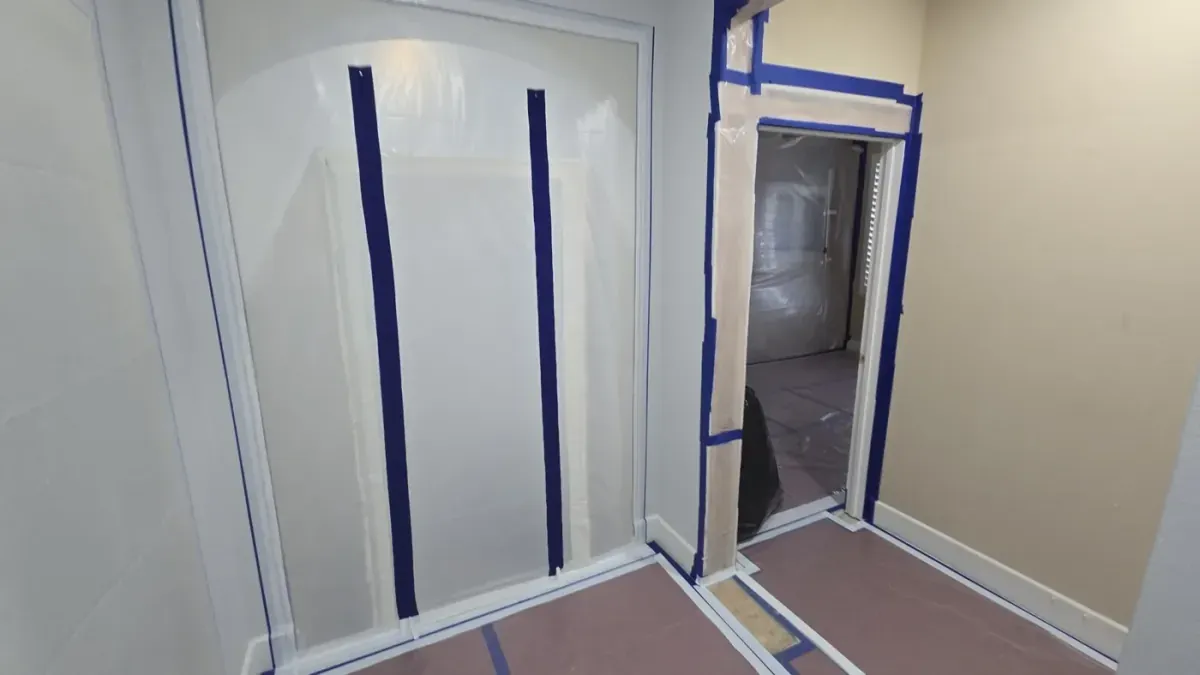
Full containment barrier with polyethylene sheeting and zip door set up during professional mold remediation

The Real Risk: How Mold Spreads During "Removal"

Mold doesn't just "sit there." When you disturb growth—even lightly—you can aerosolize:

  • Spores
  • Hyphal fragments
  • Dust contaminated with microbial particles
  • Mycotoxin-containing particles (in certain circumstances)

These particles are small enough to:

  • Travel with airflow
  • Migrate under doors and through gaps
  • Land on furniture, clothing, and stored items
  • Get pulled into returns and distributed through ductwork
  • Settle into carpet, insulation, attic contents, and porous wood

That's why proper containment is not a "nice-to-have." It's the backbone of safe remediation.

Key Components of Professional Containment Setup

1) Plastic Barriers and Critical Seals

Containment begins with proper isolation—not just throwing up plastic, but sealing it correctly.

A professional setup often includes:

  • Heavy-duty poly sheeting (often 6 mil or thicker depending on the application)
  • Full floor-to-ceiling barriers
  • Sealed seams (taped and supported so they don't fail under negative pressure)
  • Sealed penetrations and openings (recessed lights, vents, electrical penetrations, gaps)
  • Zip doors or controlled entry points (not "walk-through flaps" that leak)

If the barrier leaks, the containment leaks—especially once negative air is running.

2) Negative Air Pressure (The "Engine" of Containment)

Negative pressure means the work area is kept at a lower air pressure than surrounding areas. When done correctly, air flows into the containment—not out of it.

That matters because if the containment is positive (or neutral) pressure, particles can escape into clean areas every time:

  • A worker moves
  • A door opens
  • A fan kicks on
  • Demolition creates a dust plume

Negative air is typically created using:

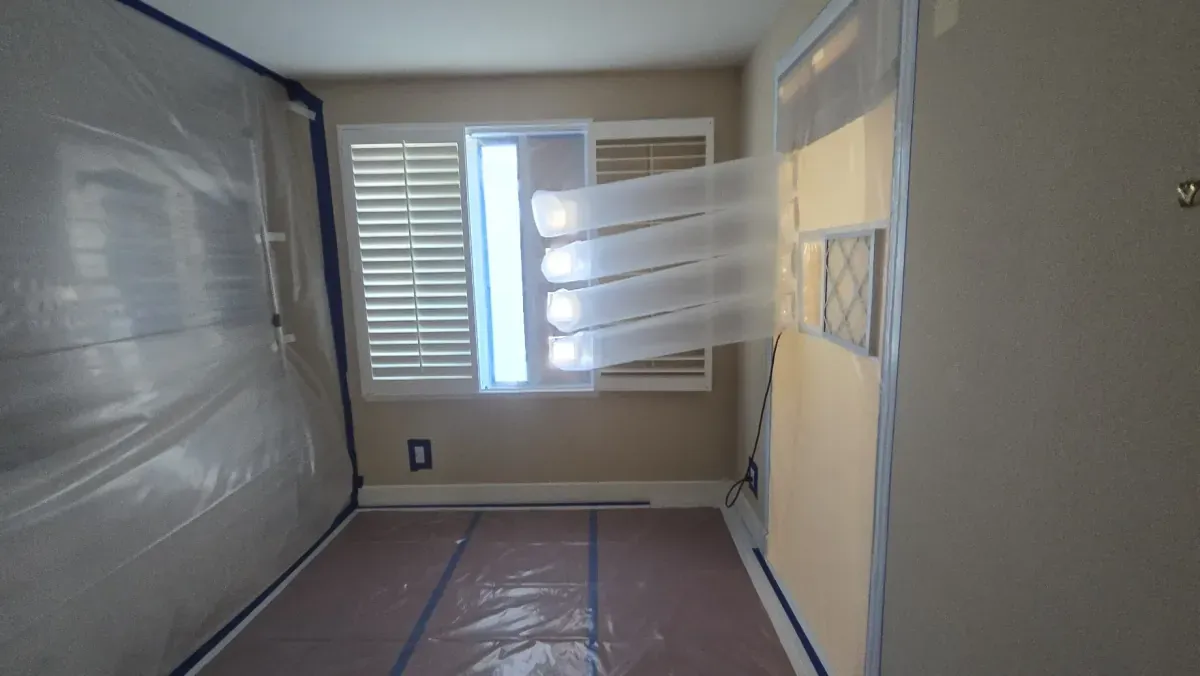
  • Negative air machines with HEPA filtration
  • Ducted exhaust to the exterior (when appropriate and safe)

This setup continuously pulls contaminated air toward HEPA filtration, reducing airborne load during work and preventing migration.

3) HEPA Air Scrubbers and Filtration

HEPA filtration is designed to capture very small airborne particles. In remediation, HEPA devices are used to:

  • Reduce airborne particulate concentration during demolition and cleaning
  • Support negative air strategies
  • Improve air conditions inside the containment as work progresses

Important detail: placing a HEPA unit in a room isn't the same as creating containment. HEPA filtration helps—but without barriers and pressure control, particles can still travel into clean areas.

4) Establishing a Decontamination Path (Clean In / Dirty Out)

A thorough containment setup doesn't just isolate the area—it also controls how people and materials move.

Professional remediation often uses:

  • A designated entry/exit point
  • A "clean side" staging zone
  • A "dirty side" work zone
  • Bag-out procedures for debris removal
  • Proper handling of contaminated materials (double-bagging, sealing before transport)

Why it matters: debris removal is one of the most common ways contamination spreads—especially when demo waste is carried through clean hallways.

5) Protecting HVAC and Controlling Airflow Pathways

Airflow is one of the fastest distribution methods in a home.

Containment planning should account for:

  • Turning off HVAC when needed during critical phases
  • Sealing supply/return vents inside the work area
  • Preventing negative air from pulling from dirty building cavities unintentionally
  • Avoiding "dust pumping" through returns

Even a small leak in the containment can become a big issue if the HVAC creates pressure differentials that pull contaminated air into the system.

6) Worker Protection and Cross-Contamination Controls

Containment isn't only about the home—it's also about preventing contaminants from leaving on:

  • Clothing
  • Tools
  • Respirators
  • Boots
  • Hair
  • Vacuums and cords

Professional protocols include:

  • PPE appropriate to the environment
  • Glove changes and clean handling practices
  • HEPA vacuuming of protective suits when needed
  • Careful tool staging and cleaning practices

The best containment in the world can be undermined if the exit process isn't controlled.

Why Proper Containment Is Critical

Prevents Mold Spread and Secondary Damage

Without containment, mold and contaminated dust can seed:

  • Adjacent rooms
  • Hallways
  • Closets
  • HVAC systems
  • Attics and crawl spaces via pressure movement

That turns a manageable issue into a more widespread contamination problem—often requiring broader cleaning, possible content loss, and a larger remediation scope.

Protects Indoor Air Quality and Occupant Health

Mold exposure affects individuals differently. Some people experience:

  • Mild allergy-like symptoms
  • Sinus irritation and throat issues
  • Headaches or fatigue
  • Asthma flare-ups or respiratory difficulty

For sensitive individuals, exposure can be more significant. Proper containment reduces the likelihood of unnecessary exposure during remediation and protects the rest of the home as a "clean refuge."

Enables Thorough, Controlled Remediation

Containment is what makes it possible to:

  • Open walls safely
  • Remove damaged materials properly
  • Clean and HEPA vacuum without re-contaminating the home
  • Focus the work where it belongs

If airflow and barriers aren't managed, you can end up chasing contamination around the house instead of eliminating it.

Improves Project Quality and Lowers Total Cost

Containment is an upfront investment that prevents expensive downstream problems:

  • Re-cleaning unaffected rooms
  • Post-remediation dust problems
  • Odor persistence
  • Re-growth in adjacent areas
  • Repeated testing failures (when clearance testing is performed)

In many cases, poor containment becomes the reason a job drags on—or needs to be redone.

What a Professional Containment Setup Often Looks Like in Real Life

While every property is different, a typical professional setup may involve:

  • A sealed poly barrier isolating the work zone
  • A controlled entry point (zip door)
  • HEPA filtration running continuously
  • Negative pressure maintained throughout the project
  • Sealed debris removal and proper disposal methods
  • Step-by-step cleaning that includes HEPA vacuuming and detailed wipe-downs

The purpose is not just "cleanup," but controlled remediation that limits spread and delivers a safer, more reliable outcome.

Common Mistakes That Spread Mold (and Why They Matter)

Running fans with no containment — This can aerosolize particles and distribute them throughout the home.

Removing drywall or insulation without negative air — Demolition creates dust plumes that settle everywhere.

Using household vacuums instead of HEPA vacuums — Many household vacuums can exhaust fine particles back into the air.

Carrying debris through clean areas unsealed — The hallway becomes the contamination pathway.

Cleaning visible growth without addressing moisture — If moisture isn't corrected, mold can return—sometimes quickly.

Our Approach at RCR Environmental

At RCR Environmental, containment is treated as a core remediation step, not an add-on. We design containment based on the structure, the affected materials, and the risk profile—then we implement it with professional-grade tools and proven methods.

Our process typically includes:

  • A containment plan tailored to the affected area
  • Isolation of the work zone with properly sealed barriers
  • Negative air and HEPA filtration as needed
  • Controlled demo and debris handling practices
  • Detailed cleaning protocols designed to reduce particulate and contamination load

Because the goal isn't just "remove what you can see." The goal is to prevent spread, remove contaminated materials correctly, and leave the space in a safer condition.

If You Suspect Mold, Don't Disturb It

If you've found visible mold or suspect hidden mold, avoid disturbing materials (especially drywall, insulation, carpet, or cabinetry) until you have a plan. The fastest way mold becomes a bigger issue is when it's disturbed without containment.

If you're unsure what level of containment your situation requires, RCR Environmental can help you evaluate the conditions and recommend the safest path forward.
Need Professional Mold Help?

Our certified team is ready to help you with mold inspection, testing, and remediation. Contact us for a free assessment.

Discussion

25 comments on “What "Containment Setup" Means in Mold Remediation

J
Jennifer M.Temecula, CA

This was really helpful. We had a contractor come out last year who just ripped out drywall with no barriers or anything. Dust everywhere. We ended up with mold in the hallway closet that wasn't there before. Wish I had read this sooner.

D
David R.Murrieta, CA

Same thing happened to us. Our guy didn't even turn off the HVAC. We found mold on the supply vents in two other rooms a few weeks later. Containment really does matter.

R
RCR EnvironmentalMurrieta, CA

Jennifer and David — what you both experienced is called cross-contamination, and it's one of the most common consequences of mold remediation done without proper containment. When contaminated drywall is cut, ripped, or broken during removal, it releases millions of mold spores into the air. Those spores are typically 2 to 10 microns in size — invisible to the naked eye and light enough to stay airborne for hours. Without physical containment barriers and negative air pressure holding those spores inside the work area, they migrate through open doorways, get pulled into the HVAC return, and settle in rooms that had no mold before the work started. David, your situation with the supply vents is a textbook example — the return vent drew contaminated air into the duct system and redistributed it throughout the house. This is exactly why the IICRC S520 standard requires containment with HEPA-filtered negative air for any professional mold remediation project. It's not about the size of the job — it's about controlling what gets released when you disturb contaminated materials. If you're ever in this situation again, the two questions to ask any remediation company before they start are: (1) will you be setting up physical containment barriers? and (2) will you be running HEPA-filtered negative air? If the answer to either is no, that's your signal to get a different company.

M
Michael T.Menifee, CA

Quick question — if we have a small patch of mold in the guest bathroom (maybe 2 square feet on the ceiling), does that still need full containment with negative air and everything? Or is that more for bigger jobs?

S
Sarah K.French Valley, CA

From what I understand, even smaller jobs benefit from at least some isolation. When we had a similar size patch removed in our master bath, the crew still put up poly sheeting and ran an air scrubber. Better safe than sorry with how easily spores travel.

R
RCR EnvironmentalMurrieta, CA

Michael, great question — and it's one we hear on almost every initial call. The short answer: yes, even a 2 square foot patch should be contained during removal. Here's why. The EPA's mold remediation guidance categorizes projects by size. Areas under 10 square feet are "Level 1" — but even at that level, the EPA recommends containment measures including polyethylene sheeting to isolate the work area. The reason is that mold colony size on the surface doesn't tell you the full story. A 2 square foot patch of visible mold on a bathroom ceiling often means moisture has been present long enough for growth to establish. What you see on the surface is the fruiting body — the reproductive structure. The root network (mycelium) can extend into the substrate well beyond the visible boundary. When you disturb that colony during removal — even a small one — you're releasing a concentrated burst of spores. In an enclosed bathroom with limited ventilation, those spores go everywhere: into the vanity cabinet, behind the toilet, into the exhaust fan housing, and into any adjacent rooms with open doors. Sarah is right — poly sheeting and a HEPA air scrubber is the appropriate minimum for a job that size. It takes a professional crew about 20 minutes to set up, it costs very little relative to the project, and it's the difference between removing the mold and spreading it. We'd be happy to take a look and give you an honest assessment. Our inspections are free and we'll tell you exactly what's needed — no more, no less.

L
Lisa G.Wildomar, CA

The section about HVAC was eye-opening. We never thought about spores getting pulled into the ductwork. Our return vent is literally right outside the bathroom where we had mold removed. Going to have someone check the ducts now.

R
RCR EnvironmentalMurrieta, CA

Lisa, that's a smart move. HVAC contamination from mold remediation is more common than most people realize — especially when the return vent is close to the work area, which is exactly your situation. Here's what happens mechanically: your HVAC return creates suction that draws air from the surrounding space. If mold spores are airborne during remediation — because containment wasn't set up, or the system wasn't shut down and sealed — the return vent pulls those spores directly into the ductwork. From there, the blower distributes them to every supply register in the house. We've tested homes where the original mold problem was a single bathroom, but post-remediation air samples showed elevated spore counts in bedrooms on the opposite end of the house. The duct system was the distribution pathway every time. For your situation, we'd recommend having the ducts inspected by a qualified professional — not just a standard duct cleaning company, but someone who can take surface or air samples from inside the ductwork to determine if mold is actually present. If contamination is confirmed, HVAC decontamination follows specific protocols including HEPA vacuuming of all accessible duct surfaces and treatment with EPA-registered antimicrobials. If you want us to take a look, we can include the HVAC inspection as part of an overall assessment. Give us a call at (951) 225-1445.

R
Robert A.Winchester, CA

I appreciate the explanation of zip doors vs. flap entries. We had remediation done on our Winchester home and the crew used proper zip doors with the sticky mat at the entry. You could actually feel the air pulling inward when you stood near the door. That's the negative pressure working, right?

K
Kevin D.Hemet, CA

Robert — yep, that inward pull is exactly what you want to feel. It means the HEPA air scrubber inside the containment is exhausting more air than what's leaking in, creating lower pressure inside vs. outside. Air always moves from high pressure to low pressure, so any gaps or imperfections in the barrier draw clean air IN rather than letting contaminated air OUT. The sticky mat is the other detail most homeowners don't notice — it traps particulates off the crew's boots so they don't track contamination into clean areas. Two simple things that tell you the company knows what they're doing.

A
Angela W.Canyon Lake, CA

We're getting quotes for mold remediation in our master bedroom closet. One company said they'd just spray and wipe, another said they need to set up containment. After reading this I'm definitely going with the containment approach. How much does a professional containment setup typically add to the cost?

C
Carlos P.Lake Elsinore, CA

It varies, but in our case the containment was just part of the overall remediation cost — they didn't charge it separately. I'd be more worried about the company that wants to skip it honestly. That's a red flag.

R
RCR EnvironmentalMurrieta, CA

Angela, Carlos is right — reputable companies include containment as part of the remediation scope, not as a separate line item. But we want to address something more important: the company that quoted "spray and wipe" for a mold problem. That approach has a name in our industry — it's called a "wipe and pray," and it's not mold remediation. Spraying a mold colony with a biocide or bleach and wiping the surface does three things wrong: (1) it doesn't address the moisture source that caused the growth, so it will come back; (2) it doesn't remove the mold — OSHA is explicit that "just killing mold is not enough; mold must be removed because the allergenic/toxic components remain even in dead mold"; and (3) it doesn't contain the spores that become airborne when you physically disturb the colony by wiping it. Real mold remediation follows a specific sequence: contain the area, establish negative air pressure with HEPA filtration, remove contaminated materials, HEPA vacuum all surfaces, apply antimicrobial treatment to cleaned surfaces, and verify the work with post-remediation testing. It's more involved than spraying and wiping — but it's what actually solves the problem permanently. On cost: for a bedroom closet, you're typically looking at a project in the $1,500 to $3,500 range depending on the extent of contamination and materials involved. That includes containment, removal, HEPA cleaning, and antimicrobial treatment. We offer free assessments if you'd like a specific scope and estimate for your situation.

P
Patricia H.Fallbrook, CA

The part about not disturbing mold yourself is so important. My husband tried to scrub mold off the garage wall with bleach and a brush. The next day I could smell it throughout the whole house. We ended up calling professionals to deal with what became a much bigger problem.

G
Greg H.Murrieta, CA

Patricia, as a fellow husband who has been told "I told you so" more times than I can count — I feel this in my soul. My wife found what she called "a spot" in our bathroom. I said "I'll handle it this weekend." I did not, in fact, handle it. I scrubbed it with a Clorox wipe, declared victory, and went back to watching football. Two weeks later the "spot" brought friends. My wife's exact words were: "Would you like to call the professionals now, or should I wait for the mold to file a formal complaint?" Some battles are not meant for DIY warriors. Mold is one of them.

K
Kevin D.Hemet, CA

Good read. I work in construction and it's surprising how many contractors still don't follow proper containment protocols for mold. The decontamination path section is spot on — I've seen guys carry bags of moldy drywall right through the living room. Education like this helps homeowners know what to look for.

A
Angela W.Canyon Lake, CA

Update: went with the company that does containment. They had the closet sealed off in about 20 minutes, ran a HEPA air scrubber the whole time, and finished in one day. The mold was actually behind the drywall too — not just on the surface. If I'd gone with the spray-and-wipe company, they would have wiped the surface and left the rest growing behind the wall. Really glad I read this article first.

P
Patricia H.Fallbrook, CA

Angela, so glad you went that route. My husband would have chosen the spray-and-wipe option because it was cheaper, and then we'd be paying for the full remediation six months later anyway. Ask me how I know.

L
Lisa G.Wildomar, CA

Following up on my earlier comment about the HVAC return vent. Took RCR's advice and had the ducts inspected — they found elevated spore counts on three supply registers and inside the air handler. Getting the full HVAC decontamination done next week. Frustrating, but at least now I know why my allergies never seemed to improve after the bathroom mold was 'taken care of.'

R
RCR EnvironmentalMurrieta, CA

Lisa, we're glad you followed through on that — and your experience is exactly why we always recommend checking the HVAC system after any mold event where the system was running during the disturbance. The ductwork becomes a secondary contamination pathway that most people never think to check. Once the decontamination is done, a post-remediation air quality test will confirm you're back to normal levels. If you need help coordinating that clearance test, feel free to reach out.

M
Michael T.Menifee, CA

Update on my 2 square foot bathroom patch: got it done with containment like RCR suggested. Turns out once they opened the ceiling, the growth extended another 3 feet behind the drywall where a slow condensation drip had been going. If they'd just wiped the visible patch, the rest would have kept growing. The containment setup took maybe 15 minutes — barely added anything to the overall time. Money well spent.

R
Rebecca N.Canyon Lake, CA

Found this article after dealing with our daughter's respiratory issues and tracing it to mold in our HVAC system (I commented on the early signs article). The company that did our remediation did use containment barriers, which is good — but reading this, I'm now wondering if they should have sealed the HVAC registers in other rooms too. Our return vent was right next to the work area. Is it possible spores got redistributed even with containment up?

D
David R.Murrieta, CA

Rebecca, that's exactly what happened to us. Containment barriers were up, but nobody sealed the HVAC. Spores got pulled through the return and showed up on supply vents in other rooms. If your daughter's symptoms aren't fully improving, it might be worth getting the duct system tested separately. That's what finally solved it for us.

G
Greg H.Murrieta, CA

Just want to confirm something from this article: when the crew does post-remediation clearance testing and the air comes back clean, is it socially acceptable to frame the lab report and hang it on the wall? Because my wife wants proof that I finally handled something correctly, and I feel like a passing air quality test is the closest I'm going to get to a trophy.

R
Robert A.Winchester, CA

Greg, I didn't frame mine but I definitely saved it in a folder labeled "Things Robert Did Right." It's a thin folder.

Leave a Comment

More Articles

Keep Reading